Poster Taste Study
I told 28 people some of these film posters might be AI-generated. None of them were. A blind study of what actually makes design read as AI, and it isn't what you'd think.
2026-07-31
I wanted to know whether people can tell AI-generated design from human design, and whether merely looking AI costs a poster in the eyes of the viewer.
So I ran a study. Eight films, three posters each: the official studio poster and two fan-made ones. Raters scored the sixteen fan posters on four dimensions, then guessed how likely each was to be AI-generated, then picked a favourite per film with the official poster finally in the running.
The AI question was a cover story. Every poster was made by a human artist. What I was measuring was suspicion: what reads as machine-made to people.
The questions
This began as an exploratory build, not a pre-registered test. The questions crystallised during the work, so the design serves several of them competently rather than one definitively.
- What visual properties make an image read as AI-generated? The primary question. Because no poster was actually AI, every point of suspicion is a clean signal about how an image looks.
- Does invoking AI change how people judge design? Tested by splitting participants: half learned the truth before picking favourites, half after. The split was never broken out as its own statistic; the only readout is the debrief reactions, and they landed the same regardless of when the reveal came.
- How do fan-made posters compare with the official studio ones? All three per film competed blind in the favourite pick.
- Does looking AI-generated cost a poster in perceived quality? This one emerged from the data rather than being planned.
How it was built
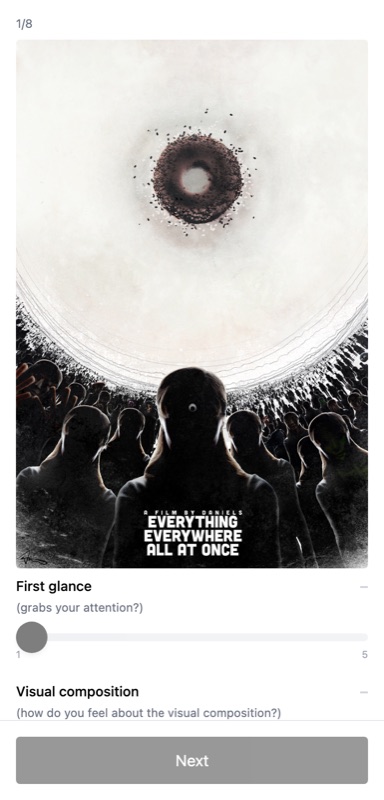
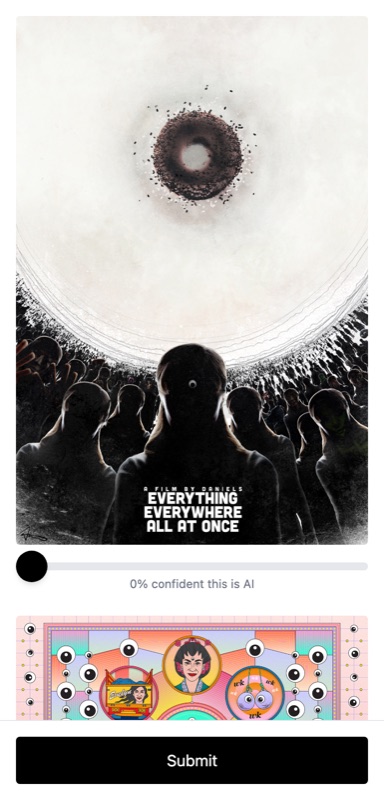
Participants rate the two fan posters per film before the official one ever appears, so the ratings can't be anchored by recognising the real thing. Left/right position and the favourite carousel are both randomised per person.
I built the whole thing: Next.js and TypeScript, Supabase behind server-only routes with row-level security, 64 unit tests on the parts where a bug would corrupt data. Two decisions mattered most:
- The native slider fought touch input, so it got rebuilt with a custom thumb that owns horizontal drag gestures without hijacking the page scroll.
- The poster carousel used to flash a blank frame between images, so all three posters in a set now render together and swap by opacity instead of by loading, with swipe added alongside the arrows.
Twenty-eight of the thirty-two people who registered finished every section, and twenty-six of those hold a genuine AI-confidence submission, the basis for the suspicion and favourite-pick numbers below.
What reads as machine-made
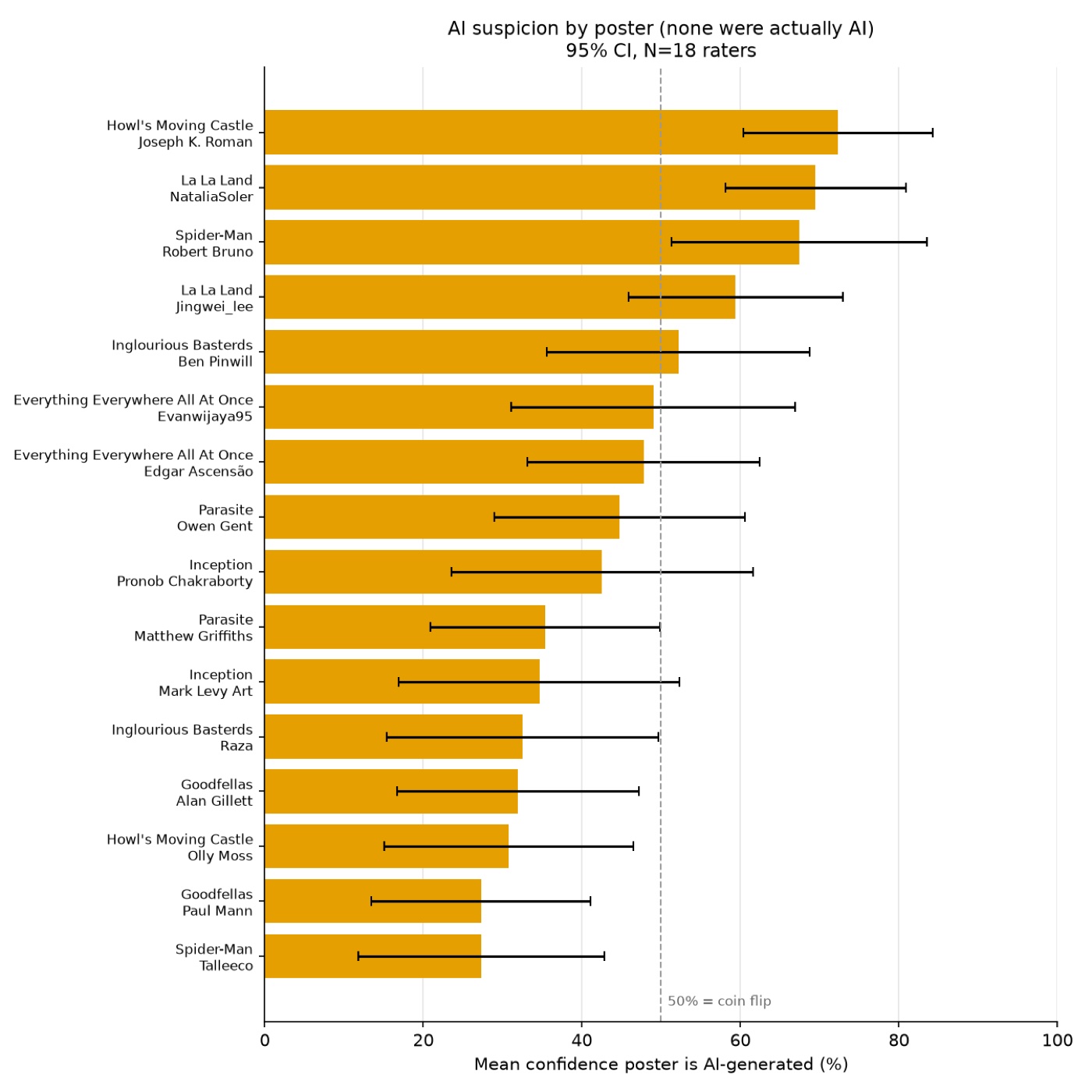
The spread in suspicion is real and wide. Mean AI-confidence across the sixteen fan posters runs from 23% to 67%, a 44-point range, and raters agree on the ordering more than chance would predict, though not tightly (Kendall's W = 0.23, p < 0.001).
Put the three most-suspected posters beside the three least-suspected and the pattern is visible:
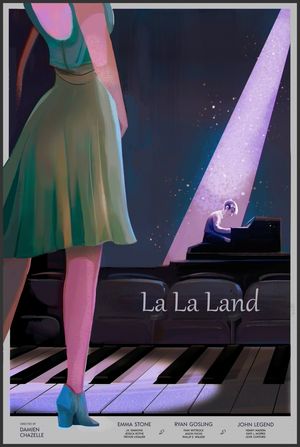
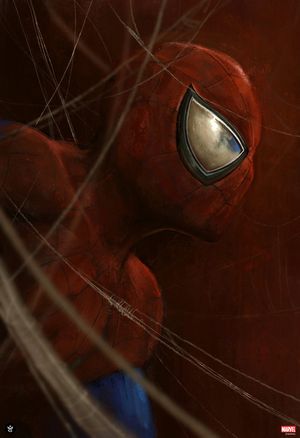

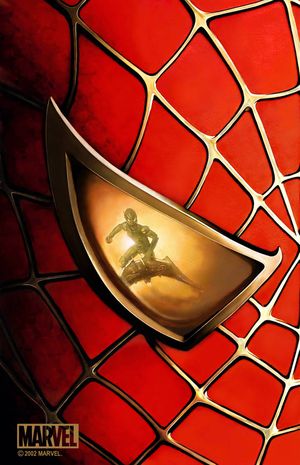
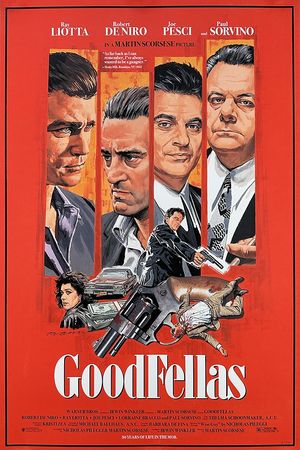
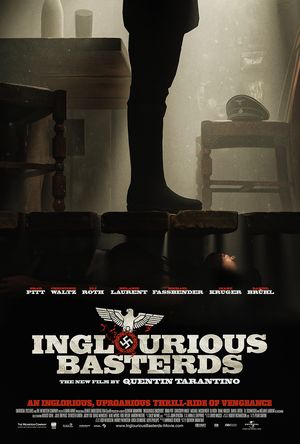
Most suspected
Soft, airbrushed gradients, glow, blended and dissolving edges, an overall painterly ambiguity where no line is quite committed, the exact texture people now associate with AI image generators. Generic to the film, keeping distance from any specific scene or plot beat.
Least suspected
Halftone and screenprint texture, decisive brush and ink marks, hard-edged graphic shapes, flat colour. References a specific plot or narrative moment directly.
People were detecting the visual signature of diffusion-model output, and reacting to whatever else happens to share it.
The cleanest evidence sits inside a single film. Both Spider-Man posters above are close-ups of the mask, same subject, same nominal technique. The soft, painterly one, brushed edges, blended reds, an atmospheric web haze that dissolves the outlines, drew 66% suspicion. The hyper-detailed one, with a sharp reflection in the eyepiece and a Marvel logo in the corner, drew 23%. One carries the tells of a diffusion model and the other doesn't. The rendering signature is what got scored.
"Looking AI" is a property of a rendering style, the soft, blended look diffusion models reliably produce, one that an overworked, gradient-heavy human illustration can share by accident, and that a confident, original, hard-edged style avoids by construction.
The rater mattered more than the poster
Before trusting any of this, I checked whether it was really about the posters, or about the one screen where the two fan posters for a film always appeared in the same relative order.
| factor | variance explained |
|---|---|
| Individual rater | 23% |
| Poster identity | 18% |
| Film | 6.3% |
| Position in the pair | 2% |
Position explains about 2%, roughly eight times weaker than the poster itself. Which film it was accounts for a further 6.3%, smaller than the poster's own identity: the specific image mattered more than which movie it was for. The single largest source of variation in the whole dataset is the raters: baseline differences in how suspicious any given person runs explain more of the variance than the artwork does. Some people ran suspicious of nearly everything, others of nearly nothing.
Does looking AI cost a poster?
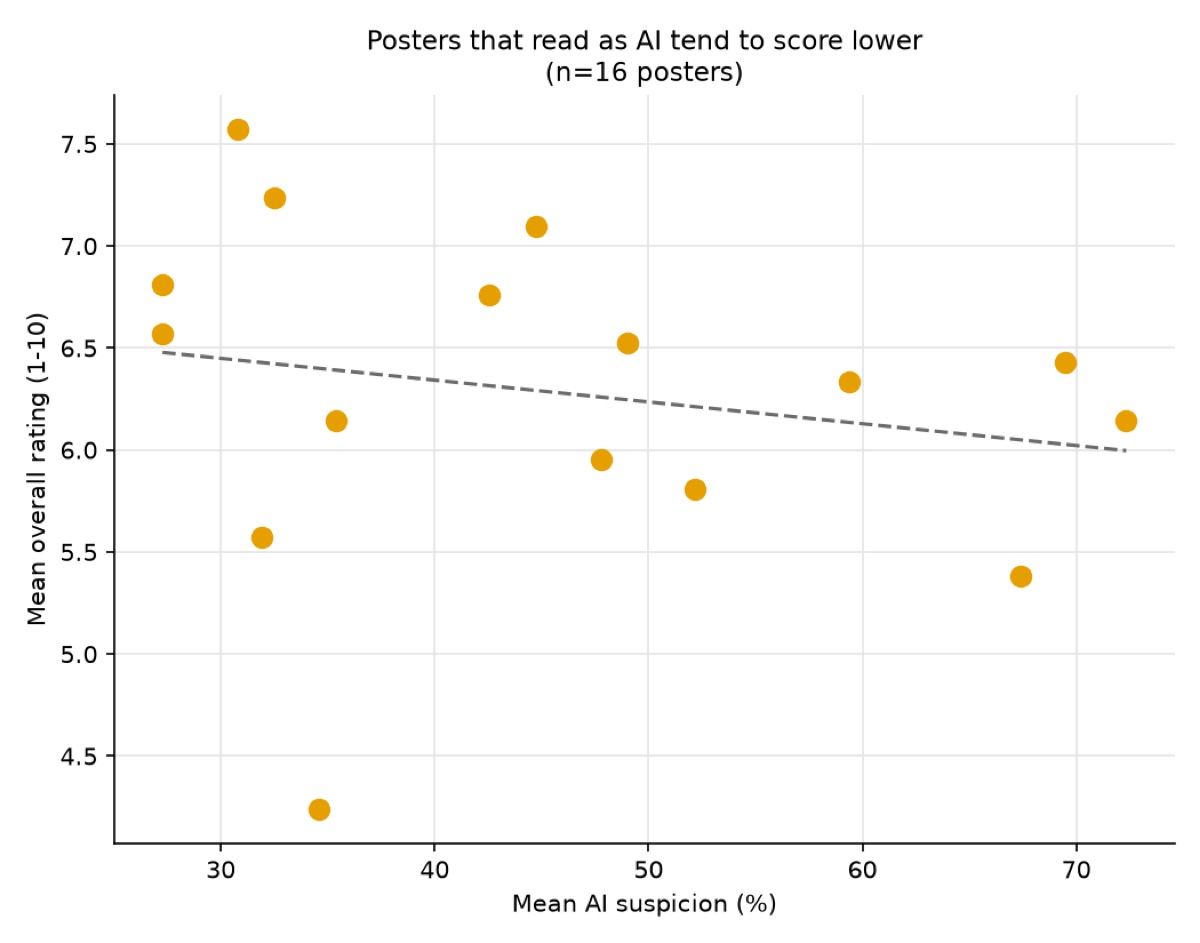
Across the sixteen posters, suspicion and overall quality correlate negatively (rho = −0.35), but at p = 0.180 that sits well short of significance at this sample size.
The favourite-pick data lets me go further than that raw correlation. When people chose between the two fan posters for a film, they picked the one they'd rated lower on AI-suspicion 75% of the time, which looks like avoidance of anything that looked synthetic. They also picked the one they'd rated higher on quality 94% of the time, and those two posters are usually the same one. Isolating the 24 cases where quality and suspicion actually pointed in different directions, where the better-looking poster was also the more AI-suspected one, quality won 20 times out of 24.
People were following their own taste. The data undercuts the causal story most people would tell about that correlation.
Official versus fan-made
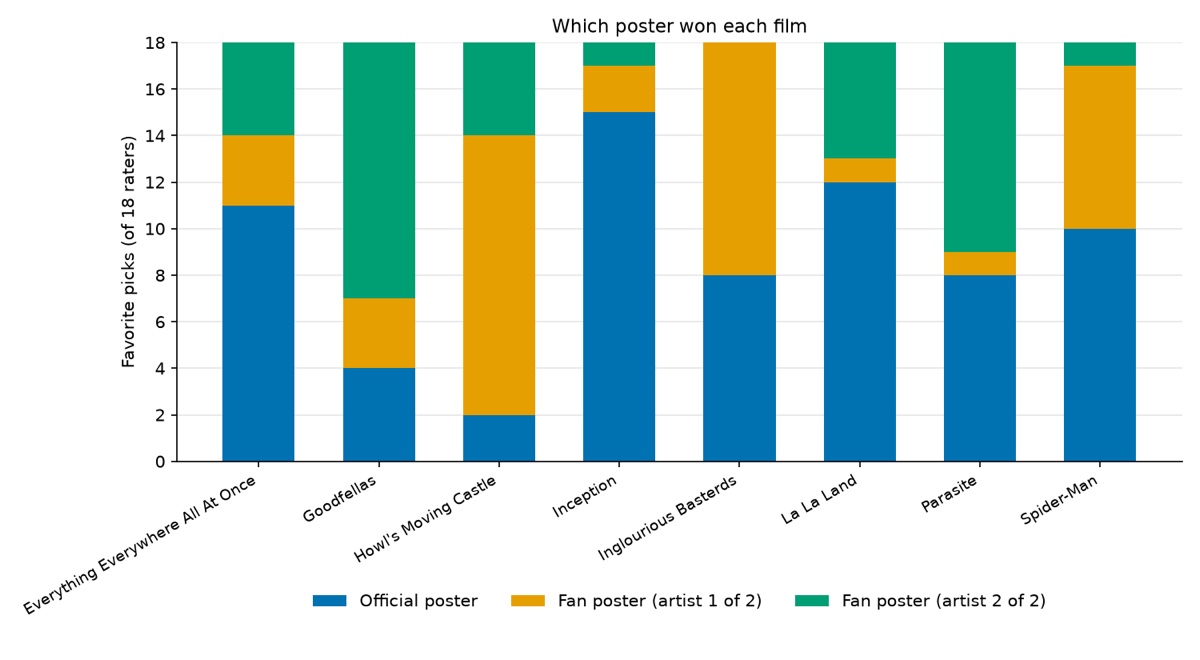
Favourite picks split close to even between the official poster and the two fan posters combined, statistically indistinguishable from chance (p = 0.89). Fan posters had two entries per film against the official's one, so an even split means the average fan poster still lost. The best fan poster beat the studio outright in three of the eight films, and Howl's Moving Castle was not close: Olly Moss took 15 of 26 votes (58%), against 6 for Roman's poster (23%) and 5 for the official (19%). Moss beat the studio and his own film's other fan poster combined.
What's next
- Code every poster on the attributes that seem to drive suspicion, edge softness, blending, tonal ambiguity, colour flatness, hard linework, and test those scores directly.
- Randomise the confidence grid. It's the only screen that still fixes pair order.
- Rate the official posters on the same four dimensions.
- Widen the sample. It currently skews 25 to 34 and design-adjacent.
Role: Sole researcher and builder. Study design, the rating application, the analysis pipeline, statistics, and write-up.
Independent study, July 2026.
Read the full data analysis → Every chart, the full variance breakdown, and the complete-case cross-check.
Poster credits
Fan posters, credited by film: Everything Everywhere All At Once, Edgar Ascensão and Evanwijaya95. Goodfellas, Alan Gillett and Paul Mann. Howl's Moving Castle, Joseph K. Roman and Olly Moss. Inception, Mark Levy Art and Pronob Chakraborty. Inglourious Basterds, Ben Pinwill and Raza. La La Land, Jingwei_lee and NataliaSoler. Parasite, Matthew Griffiths and Owen Gent. Spider-Man (2002), Robert Bruno and Talleeco. Reproduced for research and commentary; all rights remain with the artists.