Colocated Asymmetric Collaboration in AR
A user study on what happens to collaboration when one person has an AR headset and the other does not.
2025-09-01
Most research on AR collaboration studies symmetric setups — everyone has the same device, the same information, the same view. But that is rarely how technology actually enters a room. One person on the team has a new tool. The others do not. My M.Sc. thesis at TU Graz asked what that asymmetry actually does to how people work together.
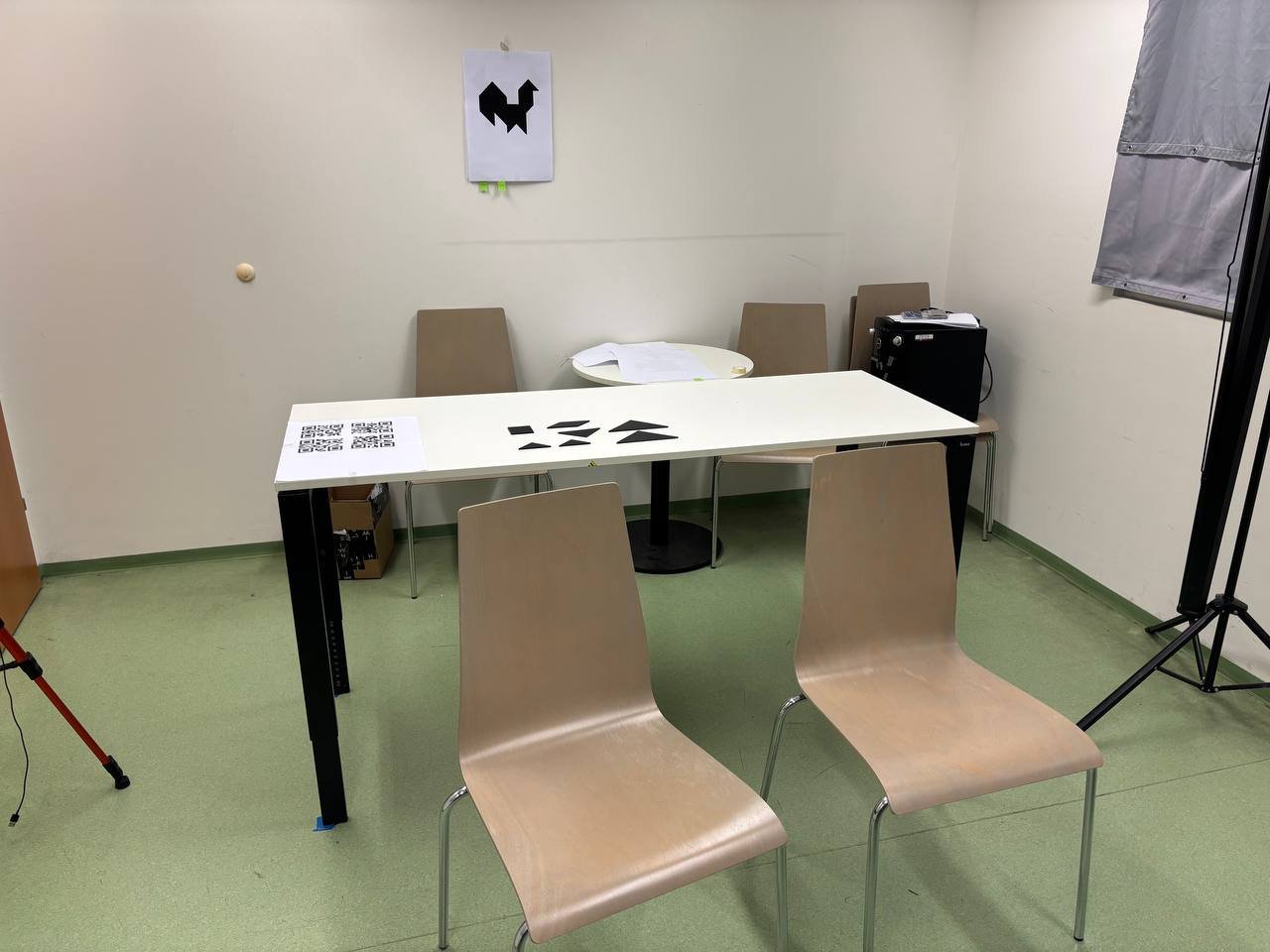
The task was a Tangram puzzle: seven flat geometric pieces that need to be assembled into a target shape. Simple to understand, genuinely hard to solve. The instructions were either on paper pinned to the wall, or projected in AR directly onto the table by a HoloLens 2.
The study design
Eleven pairs (n=22) each completed four puzzles under four conditions, counterbalanced:
- HH — both participants wearing HoloLens 2, both seeing AR instructions
- AA — both participants wearing Aria glasses, both using paper instructions only
- HA — one participant with HoloLens (AR), one with Aria (paper only)
- AH — reversed: one participant with Aria (paper), one with HoloLens (AR)
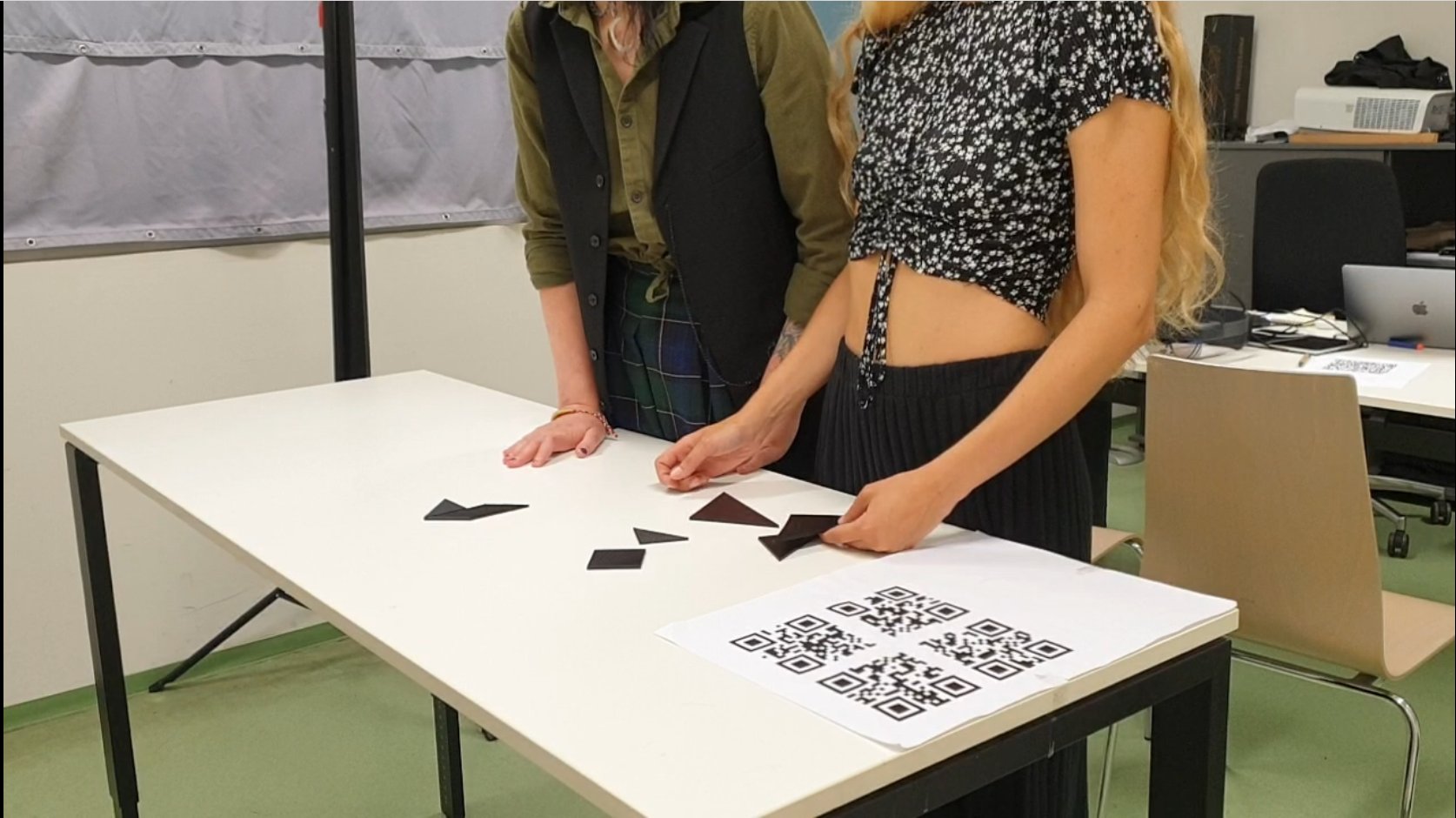
The Aria glasses (Meta's research device) were used as the passive data capture instrument for the non-AR participant — egocentric video, eye tracking, SLAM. The HoloLens 2 delivered the AR instructions and recorded its own egocentric and eye gaze data. An external camera captured audio and an overview of the workspace.
What the AR instructions looked like
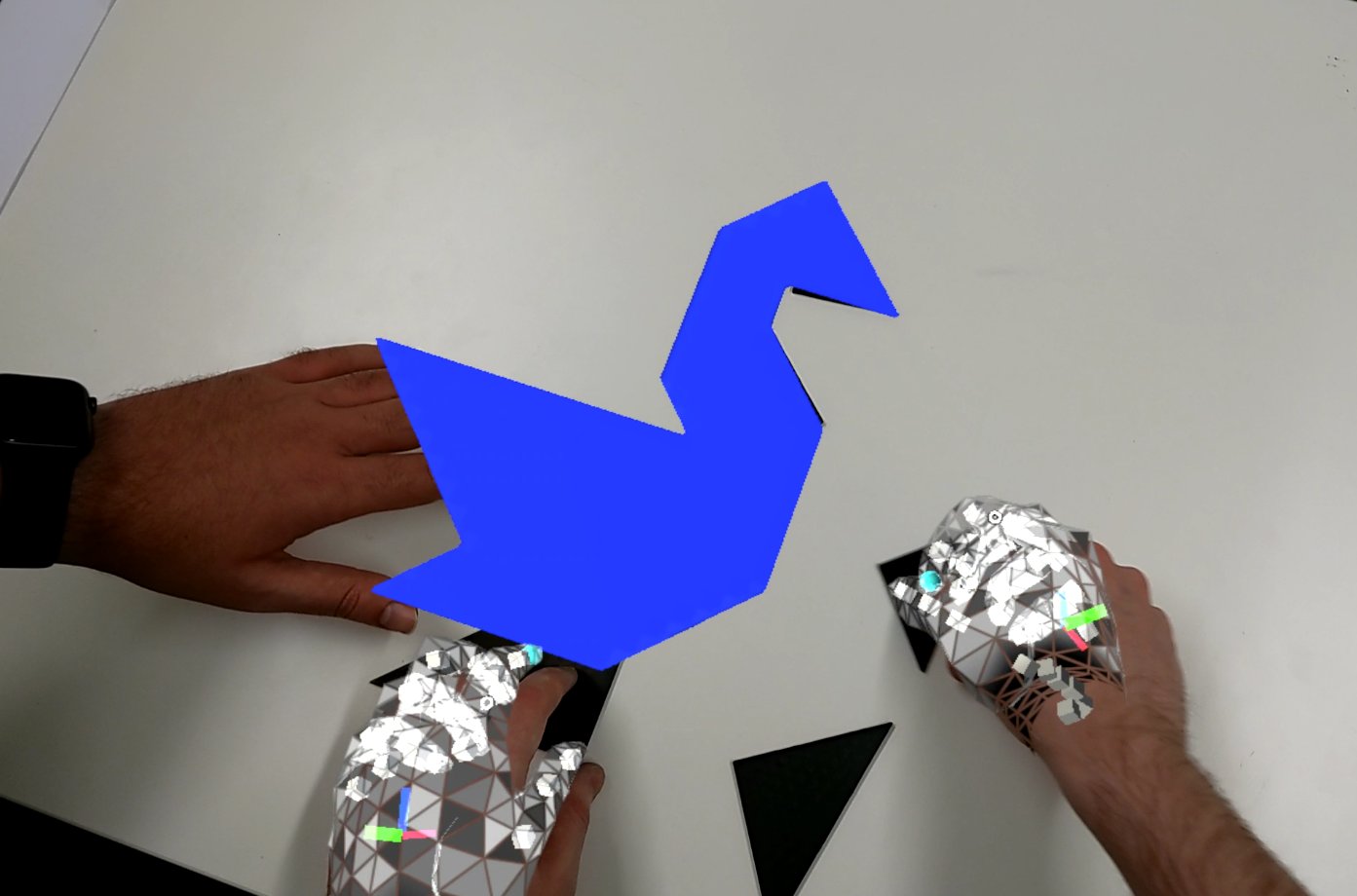
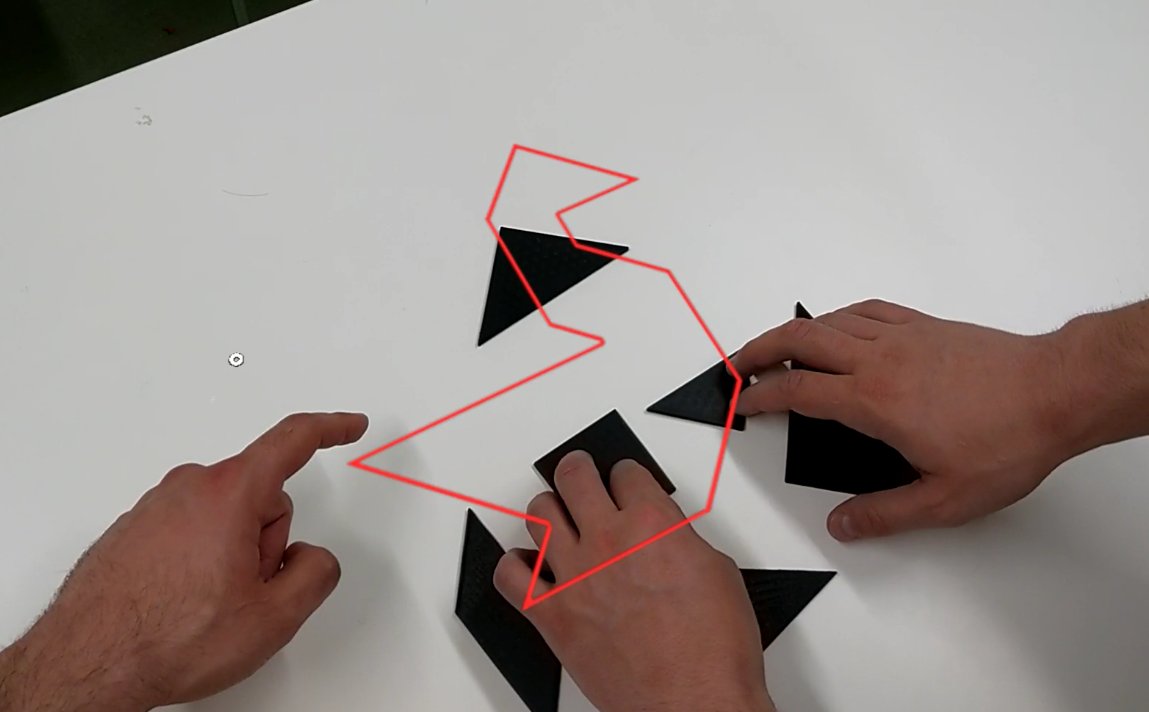
The design constraint was comparability. AR instructions should not provide information unavailable on paper, otherwise the AR condition trivializes the task and removes the need for collaboration. So the AR instructions showed an outline of the target shape projected onto the table surface — the same information as the paper, just spatially anchored to the working area.
An early prototype projected a solid filled shape in blue. The final version used a red outline, which was less obstructive and felt more like a guide than an answer.
The system was built in Unity3D. A ServerScene on a connected PC controlled recording start/stop across all HoloLens devices. A SampleScene deployed on each HoloLens managed QR code detection, coordinate alignment, instruction rendering, and data logging.
Shared coordinate system
The trickiest engineering problem: getting the HoloLens and Aria glasses to agree on where things are in space. Each device has its own coordinate frame. To compute shared gaze analyses, all data needed to be expressed in a common reference.
The solution was a QR code marker assembly placed in the corner of the table. The HoloLens detected the QR codes and used them to anchor its coordinate system. The Aria glasses post-processed their recordings through Meta's Machine Perception Services (MPS), which outputs SLAM trajectories and eye gaze data in a consistent global frame. By computing the transformation from the QR marker to each device's frame, all position and gaze data could be expressed in the same world coordinate system.
When QR detection failed for an Aria recording, multi-SLAM was used: multiple VRS files processed together, sharing coordinate frames across sessions.
What we found
HH was fastest and most preferred. When both participants had AR, they completed puzzles in less time and rated the experience highest. Shared spatial context — both seeing the same outline in the same location — removed ambiguity about which piece goes where.
Asymmetric conditions created friction. The AR user could see the target shape projected onto the table. The non-AR user had to walk to the wall to check the paper instructions. This created a knowledge gap. Eye gaze data confirmed it: non-AR participants spent significantly more time looking at the wall, and more time switching between the wall and the table.
AR users were perceived as leaders. In asymmetric conditions, participants consistently identified the AR user as the group leader — even when they reported not trying to lead. The person with better spatial information naturally directed the work. This result was statistically significant between HA and AH conditions.
AA required the most communication. Without AR, participants talked more — but this did not translate to better performance. Word count in AA was significantly higher than HH. More words, more time, more effort.
NASA TLX workload scores
Across mental demand, effort, frustration, and temporal demand, AA scored highest and HH scored lowest. The differences between AA and HH were statistically significant across all four dimensions. AR reduced not just task time, but the cognitive load of the task itself.
What this says about tool asymmetry
I think about this study whenever I see one person on a team using a powerful AI assistant and the rest not. The dynamic is structurally the same. The person with better information — whether it comes from an AR headset or a language model — naturally takes the lead. Coordination costs rise. The people without the tool spend more time trying to reconstruct a picture that the other person already has.
The AR case is controlled and measurable. The AI case is messier. But the underlying mechanism looks the same.
Role: Full thesis — study design, application development (Unity3D/HoloLens 2), data pipeline, statistical analysis, write-up. Advisor: Ass.Prof. Alexander Plopski. Co-advisor: Michael Anderson.
M.Sc. thesis, Institute of Visual Computing, TU Graz, September 2025. A journal manuscript based on this study has been submitted; I am second author.